The romanticism of many Latin American writers who aligned themselves with the left for over half a century, openly supporting the Cuban Revolution, gave birth to the pale communist monarchy that now barely inspires the contemporary intelligentsia. The manipulative power that emerged from that process, beginning in the 1960s, generated such ideological fascination that many forgot how to think for themselves. They surrendered their talent, their voice, and their silence to that David of the Caribbean who interpellated —day after day— the northern Goliath, until all slowly faded away.
And while the people rowed through the thick waters of underdevelopment, their writers —brilliant as they were— became propagandists for the longest-running dictatorship in the continent. Fortunately, the literary quality of their works survived. But not their innocence. What might have become of our nations if that intellectual potential had been invested in their development, even from a centrist position?
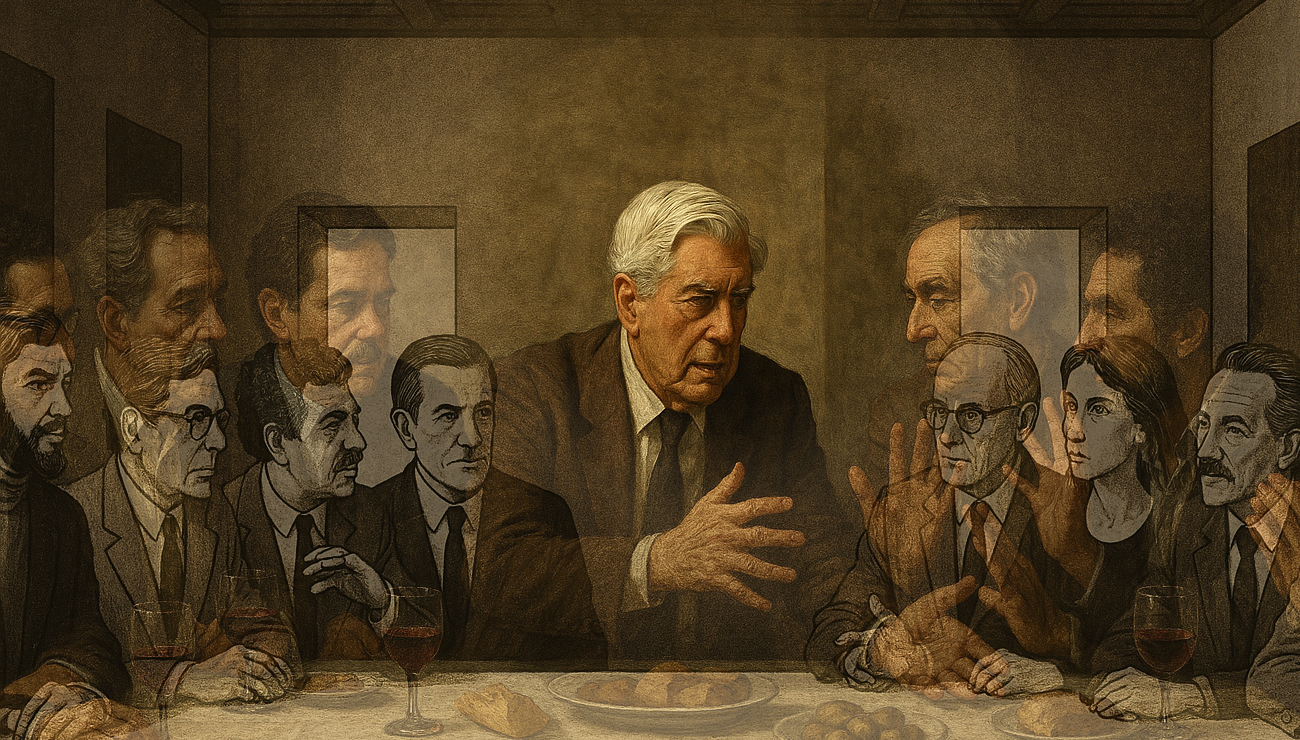
Not all gave in. Some, like Mario Vargas Llosa, chose the uncomfortable path of dissent. While Gabriel García Márquez cultivated a close friendship with Fidel Castro, and Julio Cortázar composed poems for the revolution, Vargas Llosa broke away. He denounced, distanced himself, confronted. Freedom became his banner. That’s why his work bears a unique imprint: because it owes no allegiance to any dogma.
It’s impossible not to contrast his dissent with the silence of others. García Márquez continues to be widely read, immensely great and brilliant —he remains one of my universal references in terms of literary creativity and the brilliance of his discourse—, but his indifference to Cuba’s prisoners of conscience no longer goes unnoticed. Cortázar dazzles us, but his lukewarmness in the face of repression troubles us. By contrast, figures like Octavio Paz, Jorge Luis Borges, Carlos Fuentes, and Vargas Llosa himself, knew how to write from a place of independence. From critique, not from slogans.
I write from that same border. I do not belong to any ideological trench. My gaze is critical, yes —sometimes corporate in nature— but it never abandons the suffering and fragility of the human condition. Like others, I rebel against the obligation to align. Because art that aligns becomes propaganda, and literature that obeys becomes liturgy. As Flaubert said: “We write to avoid lying to ourselves.” I would add: we write to avoid falling silent when the world is filled with deceptive rhetoric in the name of collective dreams.
That legacy, brilliant as it may be, is no longer enough. Today, we must abandon the sterile corners of politics detached from the center of thought —the very place where the middle classes should dwell: that vital space that nourishes a country’s moral and economic strength. Some Latin American lefts have become monarchies of corruption, while some right-wing movements have turned into democratic fascisms masked by institutionalism. Structural corruption, everyday violence, new forms of emotional poverty, the erosion of critical thinking, and the trivialization of hope are not resolved from ideological trenches, but from an ethical, honest, and conscious kind of writing.
The old booms responded to specific social causes. But now it’s time to make room for a new Boom: one led by writers who denounce the algorithms manipulating human life, writing from isolated corners, fueled by empathy —or by lucid antipathy.
It is not enough to remember the literature of the past. We must write the literature of the present —not as an epilogue to failed revolutions, but as an ethical prelude to a new humanity.